
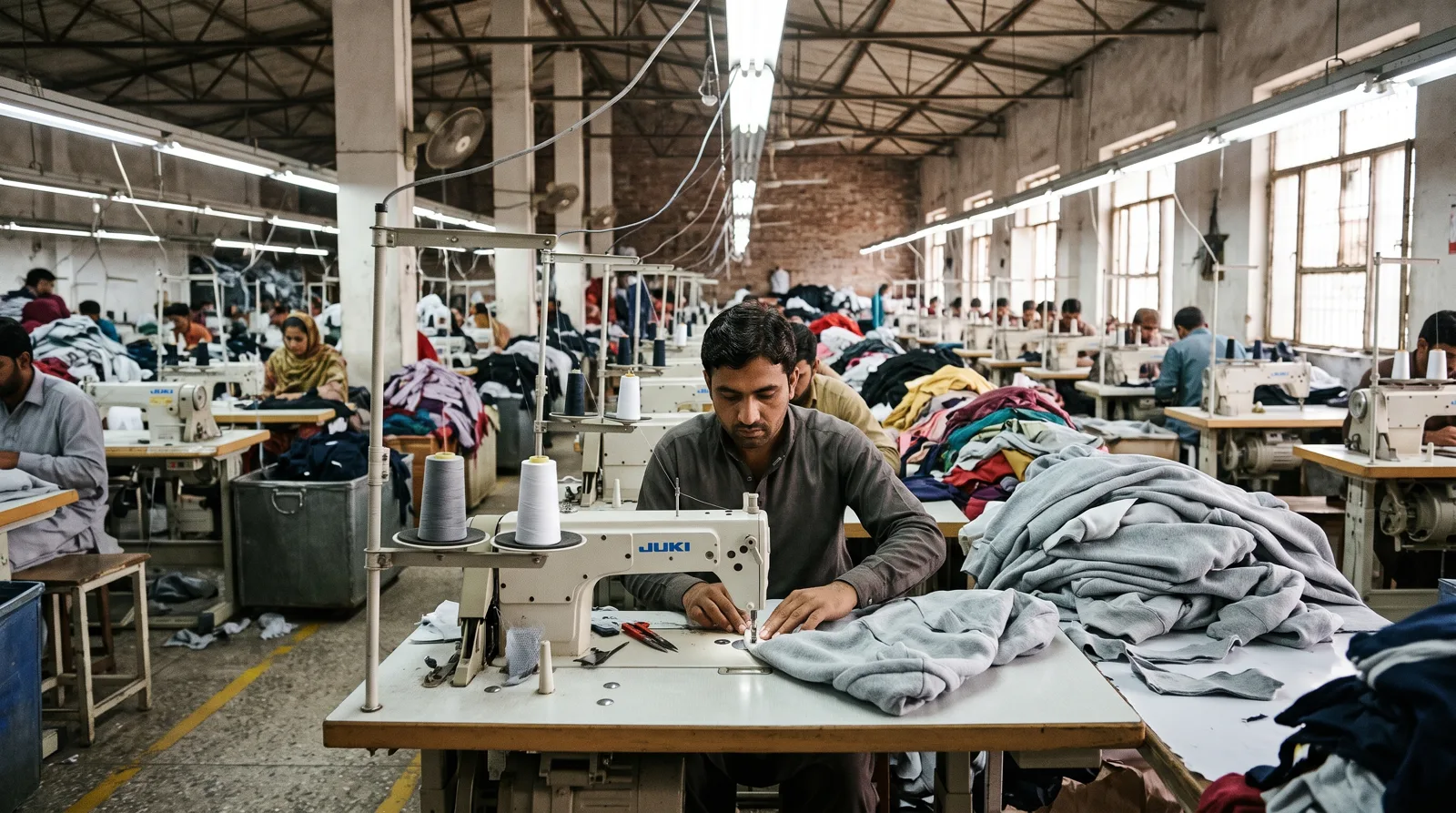
Why brands source clothing from Pakistan
Pakistan has been exporting textiles and garments for decades, and its supply chain is unusually complete: cotton growing, spinning, knitting and weaving, dyeing and finishing, and cut-and-sew production all sit within the same regions. Cities such as Sialkot, Faisalabad, Lahore and Karachi each have deep clusters of export factories supplying brands in the United States, the United Kingdom and Europe.
For a small or growing brand, that combination matters. You get a cost structure that is hard to match in domestic production, factories that already understand export labelling, packing and inspection standards, and — in the better units — genuine skill in products like fleece, jersey and sportswear. What "Pakistan" does not give you is a quality guarantee. The range runs from excellent export factories to small workshops that will struggle with an export order. The work below is how you tell the difference before your money does.
Step 1: Define exactly what you want made
Manufacturers can only quote what you can describe. Before contacting anyone, pin down the garment type, the fabric composition and weight (GSM), the fit you are aiming for, your size range, the decoration method — embroidery, screen print, DTG or DTF — and roughly how many pieces per size and colour you expect to order. A reference garment you can photograph and measure is worth pages of description.
Enquiries that say "hoodies, good quality, best price" attract vague replies and unusable quotes, because every factory fills in the blanks differently. A structured brief — ideally a tech pack — means the quotes you receive are actually comparable. If you do not have one yet, our guide to what a tech pack is explains what to include, and the free tech pack maker will build one with you.
Step 2: Build a shortlist and compare like with like
Find candidates through export directories, referrals from other founders, and targeted searches for your product category — a factory set up for streetwear fleece is a different operation from one built for sportswear and team kits. Shortlist three to five, and send every one of them the identical brief.
When the quotes come back, compare scope, not just the headline number. Does the price include sampling, labels, packaging and freight, or only the garment? Which shipping terms are assumed? A cheap quote that excludes half the scope is not cheaper. Ask each factory to state exactly what is included, and read our manufacturing capabilities page for the process steps a complete quote should account for.
Step 3: Ask the questions that reveal a real factory
A short conversation will tell you more than a brochure. Ask whether production is in-house or subcontracted, and which processes — cutting, sewing, printing, embroidery, finishing — happen under their own roof. Ask what the minimum order is per style and per colour, how long sampling takes, which markets they currently export to, and how quality is checked before dispatch. Ask who authorises shipment release, and what happens if something arrives wrong.
Then judge the answers, not the promises. A real factory answers specifically: they will talk about fabric minimums, explain why a quantity does or does not work, and flag problems in your brief. A middleman or an over-eager workshop says yes to everything instantly. Specific answers, including the occasional "no, but here is what we can do," are a good sign.
Red flags to walk away from
Some signals should end the conversation early. Be cautious with a quote that is dramatically lower than every other factory's, with no explanation of how — the difference usually reappears later as fabric substitutions, skipped steps or surprise charges. Walk away from anyone who refuses sampling and pushes you straight to bulk, anyone with no physical address who communicates only through a personal phone number, and anyone who pressures you for a full payment upfront through an unusual channel.
Also be wary of factories that show only polished stock photography and no real production imagery. A working factory can show you its floor, its machines and garments in progress. If every image looks like it came from a catalogue rather than a workshop, you are probably not looking at their work.
Step 4: Treat sampling as the real interview
The sample is where claims become evidence. Send your tech pack, confirm the sample timeline in writing, and when the sample arrives, check it properly: measure it against your specification, inspect stitching and finishing, test the print or embroidery, and wash it the way your customers will. Note every change you want in writing, get an updated sample if the changes are significant, and keep the approved sample as the reference both sides work from.
At Awexa, samples are typically ready within a week of a complete brief. Whatever factory you choose, never skip this stage to save time — as our notes on mistakes to avoid before production explain, treating a sample as optional is the most expensive shortcut in apparel manufacturing.
Communication tips that prevent most problems
Most overseas production problems are communication problems wearing a disguise. Put every specification and every agreed change in writing, even if you also discussed it on a call. Give feedback in measurements and specifics — "chest one centimetre wider, print two centimetres lower" — rather than "make it better," which means something different to everyone who reads it.
Allow for the time difference: Sialkot is nine to ten hours ahead of the US East Coast, so a question sent in your afternoon gets answered overnight. Use that rhythm rather than fighting it — batch your questions, and ask for photo updates at agreed milestones (fabric in, cutting done, sewing done, packed) so you are never guessing where your order stands.
Frequently asked questions
How do I verify a clothing manufacturer in Pakistan is legitimate?
Look for a physical factory address, real photos and video of their own production floor, and a willingness to jump on a live video call. Start with paid samples and a small first order rather than committing to a large bulk order with a partner you have not tested.
What MOQ should I expect from a manufacturer in Pakistan?
It varies widely by factory and product. Large export units may ask for thousands of pieces per style, while low-MOQ manufacturers work from around 30 to 100 pieces per style. Always ask whether the minimum is per style, per colour or per order. Our low-MOQ production page explains how smaller runs are structured.
How long does production usually take?
Sampling typically takes about a week once your brief is complete. Bulk production depends on quantity, fabric availability and decoration, so get the timeline confirmed in writing before you pay a deposit, and build in time for shipping.
Do I need to visit the factory before ordering?
Not for a first order. Thorough vetting, a live video call and a properly checked sample will tell you most of what a visit would. Many brands only visit once volumes grow and the relationship is established.
Start with a conversation
If you are shortlisting manufacturers now, send us the same brief you are sending everyone else and compare what comes back. Awexa International has manufactured custom apparel in Sialkot since 2000 — streetwear, sportswear and private label clothing from 30 pieces per style (up to 3 colours, with mixed sizes), with embroidery, DTG, DTF and screen printing in-house. Request a quote with your tech pack or design, or message us on WhatsApp at +92 300 4715677 and we will tell you honestly whether your project fits what we do.