
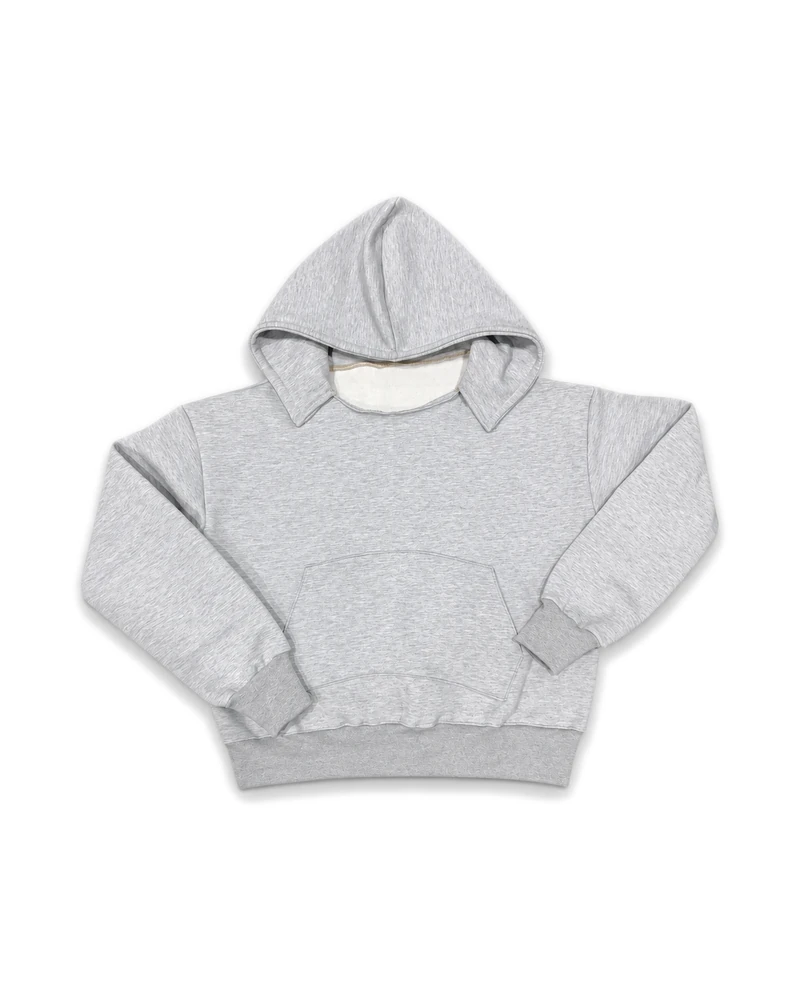
Oversized and boxy are not the same thing
Oversized describes volume. A hoodie is oversized when the body is cut wider and longer than a regular fit in the same labelled size, with more room through the chest, waist and sleeves. A size medium oversized hoodie might measure close to a size large regular hoodie across the chest — except it was graded that way on purpose, so the proportions still work.
Boxy describes shape. A boxy hoodie is wide and short: the body length is cut back so the hem sits at or just below the waistband, while the width stays generous. The result is a square silhouette that holds its shape. Most streetwear boxy hoodies are oversized too, but the two are not the same. Tell your factory "oversized" when you mean "boxy" and you will get the wrong length, the wrong drape, and a sample that looks close but never right.
The measurements that define the fit
Forget the size label — two hoodies labelled medium can differ by 10 cm across the chest. What matters is the garment measurement, taken flat, in centimetres. Here is how a boxy oversized hoodie in size medium typically compares with a regular fit; treat these as a starting point for your own spec, not a universal standard.
- Body width (pit to pit, laid flat): regular fit around 58–60 cm; boxy oversized around 66–72 cm.
- Body length (highest shoulder point to hem): regular fit around 68–70 cm; boxy oversized around 62–66 cm. Shorter on purpose — the hem should sit at the waistband.
- Shoulder width (seam to seam): regular fit around 46–48 cm; boxy oversized around 54–60 cm.
- Sleeve length (shoulder seam to cuff): often longer than regular, around 62–66 cm, because the dropped shoulder pushes the seam down the arm. The sleeve is cut wider too.
- Sleeve width (at the bicep, laid flat): regular fit around 22–24 cm; boxy oversized around 26–29 cm.
- Hem and cuff rib: the ribbed hem is usually wider and shorter than on a regular fit. A deep, tight rib pulls the wide body in and kills the square shape; a shallow rib, around 5–6 cm deep, lets the hem sit straight.
Set the chest grade early. On a regular hoodie it typically increases by 4–5 cm per size. A smaller grade of 3–4 cm keeps a boxy hoodie in proportion as the sizes go up.
How fabric weight and drape affect the fit
The same pattern in two different fabrics will look like two different hoodies. Fabric weight, measured in grams per square metre (GSM), decides whether the garment drapes or stands up. A 400–450 GSM fleece is the workhorse for this fit: enough body to hold the square shape of a boxy hoodie without going stiff. It hangs cleanly off the dropped shoulder, and the wide body keeps its line.
Lighter fleece, around 300–350 GSM, drapes more and suits a long, relaxed oversized hoodie rather than a structured boxy one. A boxy shape cut in light fabric loses its edge: the body goes soft, the shoulders round off, and the square silhouette turns into a sack. If your design is boxy, do not go light to save on fabric. The shape is the product.
Blend matters as much as weight. An 80/20 cotton-polyester fleece holds its shape well through washing. A 65/35 blend is lighter in hand and more stable in production. Pure cotton fleece feels the best and takes a mineral wash beautifully, but it shrinks more, so the pattern has to allow for it — tested on a washed sample, not guessed on paper.
How the pattern differs from a regular fit
A boxy hoodie needs a redrafted pattern. Scaling up a regular pattern lengthens the body and sleeves while keeping the original proportions.
The body block is widened through the chest and waist while the length is held or shortened. The armhole is dropped and deepened so the shoulder seam sits further down the arm, and the sleeve cap is flattened — a dropped shoulder does not need the high, curved sleeve cap of a set-in sleeve. The sleeve is widened from the bicep down, and the hood is usually cut larger — a small hood looks lost on a wide body.
None of this is visible in a photo. It is all in the pattern, and it is why a factory needs your measurements rather than a reference image alone. A reference image tells us the look you want. The spec sheet tells us how to cut it.
Construction details that make or break the look
The shoulder seam placement is the first thing anyone sees. On a dropped-shoulder hoodie the seam should sit in a deliberate, even position on both sides — if it drifts, the whole garment looks lopsided. The kangaroo pocket needs to be sized to the body too: a standard pocket on a 70 cm-wide body looks small and sits too high. Scale it up, and set it so the top edge sits level with the natural waist.
Check the hood construction on the sample. A single-layer hood in heavy fleece flops and loses its shape. A double-layer hood holds its form and feels right when it is up. If the hood has a drawstring, reinforce the eyelets at the neck — heavy fabric pulls at those points. Artwork placement shifts as well: a design placed by reference to the shoulder seam will land in a different spot once the shoulder drops, so measure placement from the centre front and the neck, not from the seam. Ribbing needs to match the fabric weight too: a 400 GSM body with a thin, light rib will pucker and pull, so use a matching heavyweight rib.
Who it suits — and who it doesn't
The boxy oversized fit suits brands selling a streetwear look, and customers who want to layer. It sits well over a tee, it photographs well because the silhouette reads clearly, and one unisex block genuinely serves both men and women if the size range is graded properly.
It does not suit every brand. If your customer wants a fitted, athletic look, or a hoodie that layers under a jacket, a boxy fit is the wrong product. The wide body bunches under outerwear and the dropped shoulder changes how a jacket sits over it. It also does not suit a customer who wants a long, draped fit — that is oversized, not boxy, and the pattern is different. Be honest about which one your customer wants before you sample — the wrong silhouette costs a week, and sampling it twice costs two.
Getting your sample right
Send a spec sheet with every measurement above, in centimetres, laid flat, for at least one size — usually medium. Include the fabric weight and blend, rib depths, pocket size and placement, and artwork placement from the centre front. If you have a reference garment, send it. A physical reference beats ten photos: we can measure it and feel the fabric.
When the sample arrives, measure it flat before you try it on, and compare every number to your spec sheet. Then try it on and check what numbers cannot tell you: the shoulder position, the hem at the waistband, the hood holding its shape. Photograph it on a person from the front, side and back, and send those photos back with your comments. Most boxy hoodies take two sample rounds to lock. Budget for that.
Cost is driven by the same things as any custom hoodie: fabric weight and quality, order quantity, decoration complexity, and labels and packaging. The fit itself does not add cost. Changing the fit after sampling has started does, so the cheapest sample is the one with a complete spec sheet behind it.
Start with the fit, not the photo
An oversized boxy hoodie is a pattern decision, a fabric decision and a measurement decision, in that order. Get the measurements into a spec sheet, pick a fabric weight that holds the shape, and sample it before you commit to a run. If you want help turning a reference or an idea into a spec sheet, a custom hoodie manufacturer that cuts its own patterns can do that with you.
Awexa International makes custom hoodies from 30 pieces per style in Sialkot, Pakistan, with cut and sew, embroidery, printing and washing in-house. Samples take about a week, bulk production about two weeks. If you are ready to start, send your spec sheet or your reference garment through our contact page and tell us the fit you are after.