
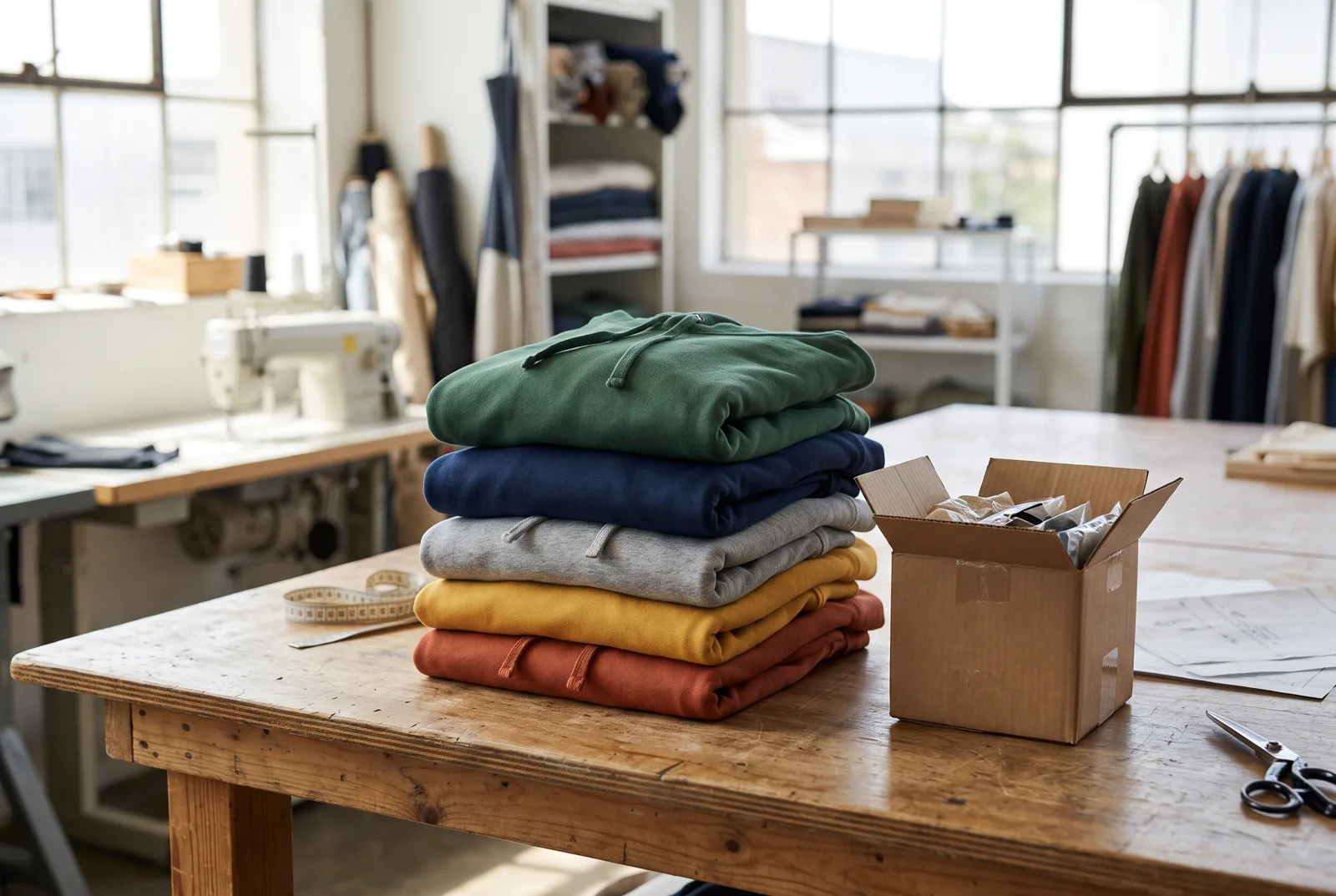
Why MOQs exist at all
Minimum order quantities are not factories being difficult. They are arithmetic. Before a single garment is sewn, someone has to make or grade the pattern, plan the marker, source fabric and trims, set up machines for that style, and brief the line. Those fixed steps cost roughly the same whether you order 30 pieces or 3,000 — so below a certain quantity, the order costs more to run than it can reasonably earn.
Fabric drives the rest. Mills and dye houses sell with their own minimums: a custom-dyed colour might require a dye lot far larger than a small order needs, and cutters lose efficiency when a lay is short. When a factory quotes an MOQ, it is usually passing these upstream constraints on to you, plus its own setup reality. Understanding that changes the negotiation completely: you are not arguing about a number, you are solving a constraint.
What "low MOQ" realistically means
For genuine custom cut-and-sew production — your pattern, your fabric specification, your labels — a realistic low MOQ sits somewhere between 30 and 100 pieces per style. At Awexa, production starts at 30 pieces, with samples ready in about a week. That is enough to launch a product, photograph it properly, sell through a first drop and learn what your customers actually want before committing serious money.
Be careful with offers that sound lower. A "minimum of one piece" is almost always print-on-demand on someone else's blank garment: fine for testing artwork, but the fit, fabric and construction are not yours, and your margin and quality control are limited. True low-MOQ manufacturing costs more per piece than mass production — that is the honest trade — but it buys you a product that is actually your brand's.
The hidden minimum: fabric and trims
The number that catches new brands out is rarely the garment MOQ. It is the fabric minimum hiding underneath it. A factory may happily sew 50 hoodies, but if your colour has to be dyed to order, the dye lot might cover 300. Custom trims behave the same way: woven labels, branded zips, drawstring aglets and custom buttons all carry their own production minimums, sometimes higher than your garment quantity.
This is why two factories can quote wildly different minimums for the same product. One is assuming mill fabric dyed to your colour; the other is working from fabric it can source in short runs. When you compare quotes, ask each factory what the MOQ is made of — garment, fabric and trims separately — so you know which constraint you are actually negotiating.
Workarounds that genuinely work
Small brands get around fabric minimums every day, mostly by being flexible where customers cannot see it and specific where they can. The most reliable strategy is to build your first run on stock fabrics — the core fleece, jersey and twill qualities a factory already holds or can buy in short lengths — instead of commissioning a custom fabric. Standard colours from the mill's existing range avoid dye-lot minimums entirely, and a well-chosen black, navy or heather reads as a deliberate brand choice, not a compromise.
Sharing one fabric across several styles stretches a fabric minimum over more garments: the same fleece can carry a hoodie, a crewneck and joggers in one drop. Keeping trims standard where they are invisible — plain zips, stock buttons — while spending on the one visible signature, usually your woven label, protects both the budget and the brand feel. And simplifying the first range matters: fewer colourways and a tight size split in round one, expanded once the product has proven itself.
How to negotiate without damaging the relationship
Start by being straight about your stage. Factories that serve small brands expect first orders to be small; what they respond to is a buyer who understands the constraints and plans to grow. Ask what drives the minimum for your specific product, then solve that piece: accept the stock fabric, consolidate colours, or adjust the style split. Flexibility on the constraint earns more than pressure on the number.
What does not work is bluffing. Promising thousands of pieces next season to unlock a lower MOQ today is the oldest line in the industry, and factories price it as fiction. A cleaner approach is a structured start: samples now, a genuine first run at an achievable quantity, a reorder conversation once you have sell-through data. That is the sequence factories trust, because it is the sequence that actually happens with brands that succeed. Our manufacturing page shows how a run moves through the factory once it is booked.
What low quantities mean for your unit cost
Expect the per-piece price on a 30 to 100 piece run to sit higher than on a volume order, for reasons you can now name: fabric bought in short lengths costs more per metre, setup time is spread across fewer garments, and sampling and approvals are a bigger share of the whole job. None of that is padding; it is the same fixed costs divided by a smaller number.
Plan your retail price with that reality in it rather than discovering it later. Many brands treat the first low-MOQ run partly as market research: it validates the fit, the fabric and the price point with real customers, and the reorder — at a better unit cost, on a proven product — is where the margin improves. Coming in with a complete brief also helps: a factory quotes more keenly on a job it can cost precisely, so a proper tech pack is worth building before you ask for numbers.
Frequently asked questions
Can I order fewer than 30 pieces?
A handful of pieces is sampling, not production, and any factory can make singles as samples. The per-piece cost reflects sample-room time rather than line production, so it only makes sense for development and photography, not for stock you intend to sell at a margin.
Why does one factory quote an MOQ of 50 and another 500?
They run different production models. A factory with large sewing lines and mill-direct fabric buying needs volume to stay efficient. A smaller, flexible unit that holds stock fabrics and sews in-house can profitably run far shorter orders. Neither is automatically better; match the model to your stage.
Can I mix sizes and colours within an MOQ?
Sizes, almost always yes: an MOQ is usually per style, split across your size range. Colours are the tighter constraint, because each colourway may carry its own fabric or dye minimum. Ask how the factory counts it before you plan your range.
Will a factory lower its MOQ for a first order?
Sometimes, when the constraint behind the minimum is flexible — for example when a stock fabric is already on hand. The way to find out is to ask what drives the minimum for your product and solve that constraint together, rather than simply asking for a discount on the number.
Start small, properly
A low-MOQ first order done well — right fabric, approved sample, your labels, clean finishing — beats a large order done blind. Awexa International produces custom streetwear and sportswear from 30 pieces in Sialkot, with embroidery, DTG, DTF and screen printing in-house and samples in about a week. Request a quote for your first run, or message us on WhatsApp at +92 300 4715677 and tell us what you are planning to make.