
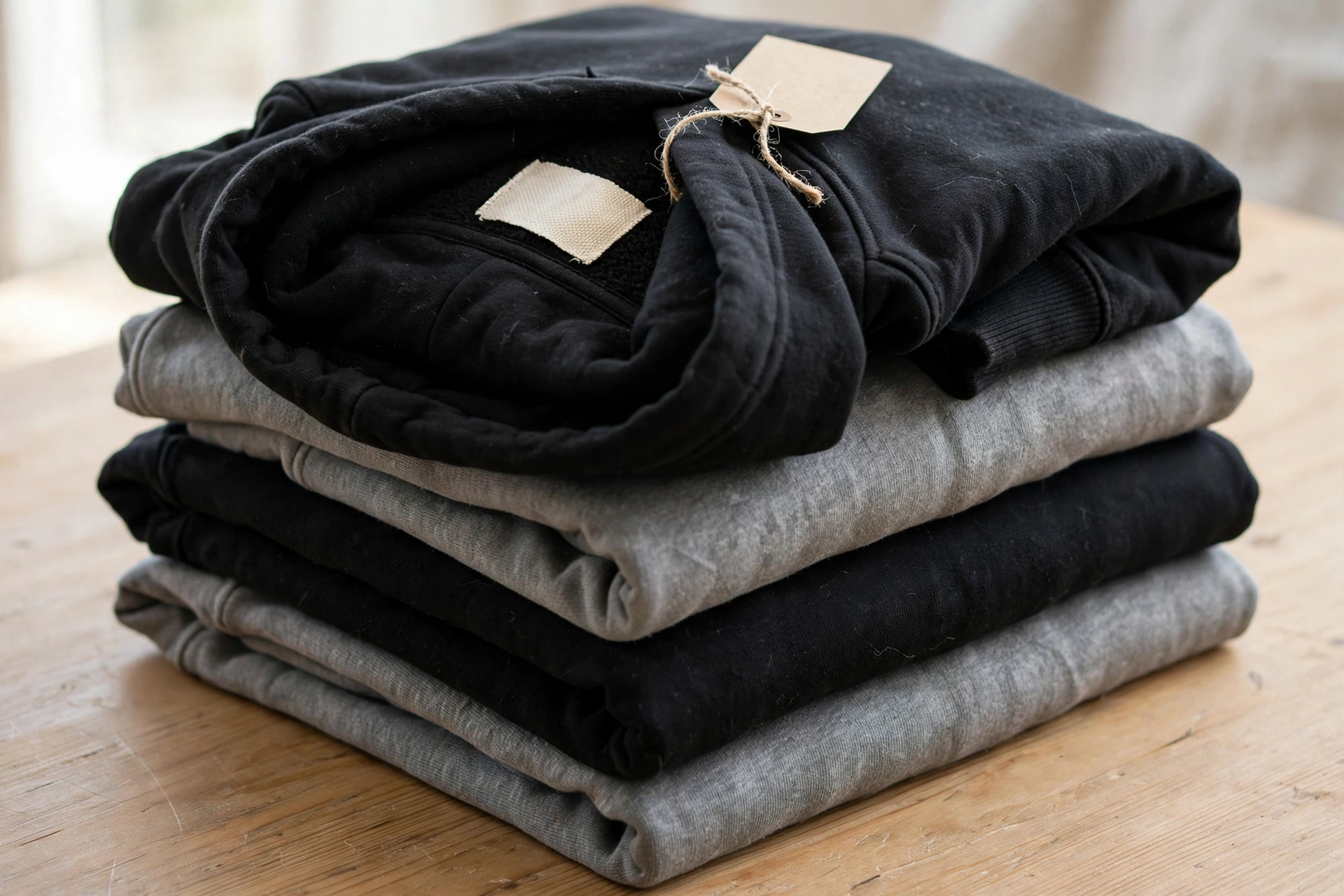
Start with the product, not the logo
People buy a hoodie for how it fits and feels. The logo means more once they like the garment.
Start with one or two products, such as a heavyweight hoodie with matching joggers or a hoodie and a tee. Each new style adds a pattern, a sample and fabric to source, which leaves more room for mistakes. Add styles once you know what customers buy.
Know who the clothes are for before you think about decoration. A boxy, oversized hoodie and a slim athletic one are different garments — different patterns, different fabric, different customers. If you can describe your buyer in one sentence, the manufacturer can make decisions for you. If you can't, it has to guess, and guesses cost samples.
What a manufacturer needs from you
For a quote, give the factory a tech pack with enough detail to show what you want it to make:
- A flat sketch, front and back, with every detail drawn: pocket shape, hood construction, ribbing, drawstrings, stitching.
- Measurements for every size, laid flat: chest, body length, sleeve length, shoulder, hood dimensions. No measurements? Say so — a factory can build a standard size chart for you, but you need to approve it before production.
- Fabric specification: type (fleece, French terry, jersey), weight in GSM, blend (100% cotton, 80/20 or 65/35 cotton-polyester), and colour.
- Decoration: screen print, DTF print, puff print, flat embroidery or 3D puff embroidery — where, and how big.
- Labels and packaging: woven main label, neck label, size label, hang tag, and how the garment should be folded and bagged.
Send a reference hoodie with the fit you want. The factory can measure it and use it as a starting point.
Why MOQ 30 is a good place to start
Thirty pieces per style is low enough to launch with and high enough to be real production — a drop you can photograph, sell and learn from without tying up serious money. It is also enough for a factory to run properly, on a real line rather than as a one-off in the sample room.
The 30 is per style, not per order — 30 hoodies and 30 tees is two minimums. You can mix sizes and colours within those 30 pieces: at Awexa, one order can run across up to three colours with mixed sizes. Send your size and colour breakdown with the brief. Our guide to low MOQ clothing manufacturing explains why minimums exist.
Sampling: the step you don't skip
Before any bulk order, the factory makes a sample — the single most important step, and the one new founders are most tempted to rush.
A sample takes about a week, made in your fabric, to your measurements, with your decoration and labels. When it arrives, wear it, wash it, and check the decoration up close — does the print crack when the fabric stretches, does the embroidery sit flat?
Then send your corrections back in writing, with photos and measurements. "Make the hood bigger" is not a correction. "Increase hood width by 2 cm" is. The factory works from numbers, not adjectives.
Expect at least one round of corrections — that is normal. Never approve a sample you are not happy with because you are in a hurry: every problem you accept at the sample stage becomes thirty problems in bulk. Bulk takes about two weeks once the sample is approved.
Choosing the fabric
Fabric weight and blend decide how a garment feels, drapes and lasts — the first thing a customer notices when they pick it up.
For hoodies, the workhorse is fleece: 400 to 450 GSM in an 80/20 or 65/35 cotton-polyester blend gives you a heavy, structured hoodie that holds its shape. A 100% cotton fleece feels softer but costs more and shrinks more in the wash. French terry is lighter, with a looped back instead of a brushed one — good for a lighter hoodie or a sweatshirt you want to layer. For tees, a 220 to 250 GSM cotton jersey is a solid starting point: heavy enough to feel like streetwear, not so heavy it drapes like cardboard.
Build your first drop on fabrics the factory already holds or can buy in short runs — a custom-dyed colour might need a dye lot far bigger than a 30-piece order can use. Stock colours (black, grey, navy, off-white) read as deliberate choices, not compromises.
Private label: making it actually yours
Private label is what turns a well-made hoodie into your brand's hoodie: your woven main label, neck label, size label and hang tag — not the factory's, not a blank.
Woven labels take time to produce, so confirm them during sampling, not after bulk is booked. Fibre content and country of origin belong on the care label, and they need to be correct.
Decoration is a separate decision. Screen printing suits bold graphics; DTF handles detailed, multi-colour artwork at small quantities; puff print adds a raised finish to a chest logo; flat embroidery is clean and durable for small marks, and 3D puff embroidery gives a raised effect for bold lettering. A good manufacturer will tell you which method suits your artwork.
Choosing a manufacturer
Do they do the work in-house? Cut and sew, embroidery, printing and washing under one roof means fewer handoffs and one place responsible when something goes wrong.
Do they ask you questions? A factory that quotes from a single photo without asking about fabric, sizes or labels is guessing. The questions are the quality control.
Are they honest about timelines? Samples in about a week and bulk in about two weeks is realistic. Anyone promising three days for a full custom run is cutting corners.
Do they show you real work? Ask for photos of finished garments — not mockups, not renders, actual pieces that came off their line. And do they communicate? A factory that replies promptly, confirms details in writing and sends photos at each stage is worth more than one that is slightly cheaper and goes quiet for a week.
If a factory's price is dramatically lower than everyone else's, something is being left out — fabric weight, label quality, finishing, or shipping. Ask what is included, and ask early who pays the freight and handles customs.
What drives the cost
Nobody can give you a per-piece price without seeing your tech pack. What you can understand in advance is what drives the cost.
Fabric weight and blend matter: heavier fleece costs more per metre than light jersey, and 100% cotton costs more than a blend. Quantity matters: the fixed setup — pattern, grading, machine setup, print screens, embroidery digitising — is spread across however many pieces you order, so 30 pieces costs more per piece than 100. Decoration complexity matters: a five-colour screen print costs more than a one-colour print, and 3D puff embroidery costs more than flat. Labels and packaging add up too. A complete brief gets you a better quote.
Common beginner mistakes
Ordering too many styles at once. Three products done well beat eight done badly, and eight styles means eight samples to approve.
Skipping the sample, or approving it without wearing it, washing it, and checking the measurements. The sample is your only chance to fix things cheaply.
Forgetting the boring details. Size breakdowns, colour splits, label text, packaging, shipping address, payment terms — these are not admin, they are the order. A missing size split delays cutting by days.
Treating the first order as the whole business. The first run is a test — it proves the fit, the fabric, the price and the demand. The reorder, on a proven product, is where the margin improves.
Your first order, step by step
- Decide your first one or two products and who they are for.
- Build a tech pack — or send reference garments and detailed photos and let the factory help you build one.
- Get the sample made, wear it, wash it, measure it, and send corrections in writing.
- Approve the final sample. Only then confirm the bulk order, the size and colour breakdown, the labels and the packaging.
- Pay the agreed deposit and let production run — about two weeks for bulk.
- Check the finished goods photos before shipping, and inspect the delivery when it lands.
That is the whole process. A manufacturer that walks you through these steps instead of rushing you past them is one worth working with.
Start with a sample
The best way to judge a manufacturer is to make something together. Awexa International produces custom streetwear in Sialkot, Pakistan — heavyweight hoodies, tees, joggers and more — from 30 pieces per style, with cut and sew, embroidery, printing and washing in-house and samples in about a week. Send your tech pack through our contact page.