
The short answer
A sample takes about a week. Bulk production takes about two weeks. For a straightforward order — a hoodie or a tee in a fabric we hold or can buy quickly, with your artwork ready — those numbers hold.
Allow five or six weeks from your first message to delivery on a first order. That includes fabric sourcing, decoration setup, approvals and shipping.
What the week of sampling actually covers
The sample gives you a physical garment to try on and check. It starts with the pattern: from your tech pack if you send one, or drafted from a reference garment or a sketch — which takes a little longer and usually means more back-and-forth.
Then the fabric is cut, the garment is sewn, and the decoration goes on — embroidery digitised and stitched, a screen print set up and run, a DTF transfer pressed. Labels go in: your woven neck label, the care label, the hang tag. Then it is pressed, checked against your measurements, photographed and shipped.
That is a lot of steps for one garment, which is why a week is a fair estimate rather than a promise of three days. A sample that arrives in two days was rushed through one of those steps, and you will feel it in the fit or the finish.
The approved sample is the reference for checking the bulk run. Every decision at this stage — fabric weight, rib tension, print placement — locks in for production. Time spent getting the sample right is the cheapest time in the whole order.
The two weeks of bulk production
Once you approve the sample, bulk production has its own sequence, and most of it cannot be compressed.
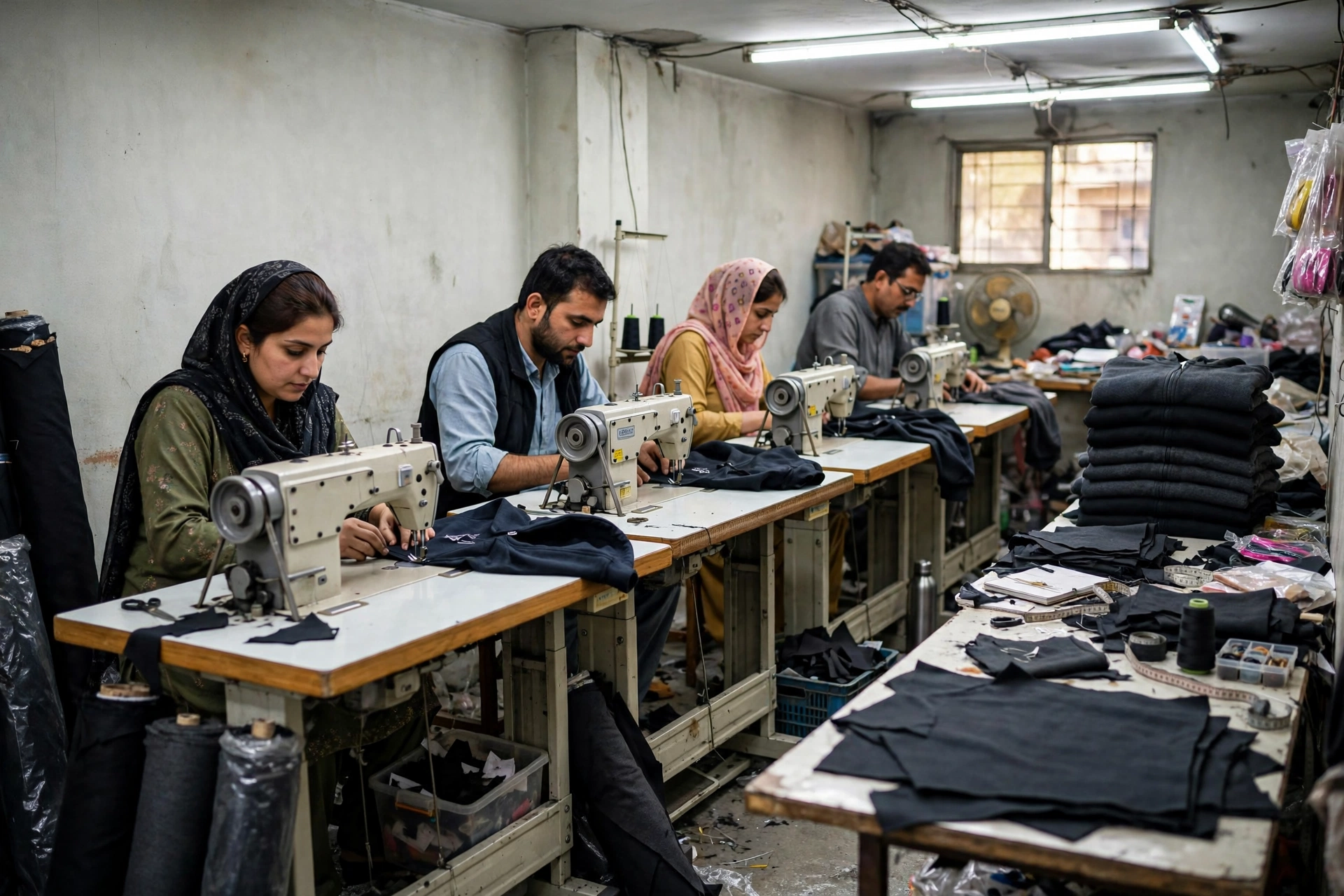
First, fabric is bought or dyed to your colour and quantity, then cut in lays — layers stacked and cut together. Then the pieces move through the sewing line: body, sleeves, hood, ribbing, trims. Decoration happens alongside or after sewing, depending on the method and the placement — embroidery can go on before or after assembly, screen printing and DTF usually after the garment is sewn.
Then washing, if your style needs it — a mineral wash happens after printing and changes the hand feel and the measurements, so it has to be planned in from the start. Then pressing, quality checking piece by piece, folding, bagging, tagging, and packing into cartons.
Two weeks covers a normal order at our minimum of 30 pieces per style. Bigger orders take longer, but not in proportion — a 300-piece run is not ten times a 30-piece run, because the setup is the same and only the sewing time grows.
What moves the timeline
Five things push a timeline out or pull it in.
Fabric sourcing. This is the biggest variable. If your fabric is a stock quality we already hold — a standard 400 GSM fleece, a cotton jersey, a French terry — production can start as soon as the sample is approved. If your colour has to be dyed to order, or a fabric has to be woven or bought from a mill, add time before cutting starts. A custom-dyed colour can add a week or more, and no amount of rushing on the sewing line recovers it, because the fabric simply is not there yet. Our manufacturing page runs through the fabrics and processes we work with in-house.
Sampling rounds. One sample round keeps you on schedule. Each extra round adds about a week. Fit corrections are part of the process, and a second round is common on a first style. But three or four rounds usually mean the brief was unclear at the start, not that the factory is slow. A complete tech pack — measurements, fabric specification, artwork in the right format — is the single best way to keep sampling to one or two rounds.
Decoration. Simple decoration is fast: a one-colour chest print or a small flat embroidery adds little time. Complexity adds days — multi-colour screen prints need a screen per colour, 3D puff embroidery needs digitising and a test run, a mineral wash needs a wash trial first. Mix methods and each one is a separate setup, run in sequence, not all at once.
Quantity. At 30 pieces, the line moves fast. At a few hundred, cutting, sewing and checking all take longer, because every piece still gets checked. The jump from 30 to 100 pieces adds days, not weeks. The jump to a thousand adds weeks and needs to be booked on the line in advance.
Shipping. This is the part brands forget to count. Air freight to the US or Europe takes days; sea freight takes weeks. The clock stops when the garments are in your hands, not when they leave the factory. Ask for the delivery time, not just the production time, and plan your launch around the later date.
Planning backwards from your launch date
If you are planning a short first run, use the small-batch production page to prepare your quantities before you ask for a schedule.
Start at the date you want to sell and work backwards. Say you want a drop live on 1 March.
- Delivery and buffer — two weeks before launch. Time for the garments to arrive, be photographed, and be listed, plus a few days of buffer for customs or a courier delay.
- Bulk production — two weeks before that. Your sample has to be approved and signed off before bulk starts.
- Sampling — one to two weeks before that. A sample takes about a week, plus shipping to you and a day or two for you to check it and reply.
- Brief and fabric — one week before that. Send your tech pack, confirm the fabric and colour, and agree the decoration.
Worked backwards, a 1 March launch means your brief should be with the factory in early January. That sounds early. It is the difference between a drop that lands on time and one that lands two weeks late because nobody counted the dyeing week.
What slows an order down
Most delays are not factory problems. They are gaps in the brief.
Late artwork. A logo sent as a low-resolution screenshot instead of a vector file stops embroidery digitising and screen making cold. Send print-ready files — vector for embroidery and screen print, high-resolution for DTF — and check them before you send, not after.
Fabric minimums. A mill will not dye ten metres of fabric in your exact shade. If your colour is custom, the dye lot may cover far more fabric than your order needs — so you either wait for a workaround or pick a stock colour. Decide this during sampling, not during bulk, and you save a week.
Approval delays. The factory sends a sample, photos, or a measurement sheet, and then waits. Every day you take to reply is a day the line is not booked for your order. If you need a few days to check a sample, say so up front — the factory can hold your slot. Silence loses it.
Rework. A sample that comes back with a new design — a different pocket, a changed print, a new fabric — is not a correction, it is a restart, and it costs another sample round. Get the design settled before sampling starts, and use the sample rounds for fit and finish, not redesigns.
Missing trims. Woven labels, custom drawstrings, branded buttons and printed care labels each have their own lead times. Order them when you approve the sample. The bulk order has to wait if they arrive late.
How to keep your order on time
The brands whose orders land on schedule do the same few things. They send a complete brief the first time: tech pack, measurements, fabric and GSM, artwork in the right format, size and colour breakdown. They approve or correct the sample quickly, with specific notes — "take the body in 1 cm at the waist" beats "the fit feels off." They settle fabric and trims during sampling, so nothing is still open when bulk starts, and they build a buffer into their launch date instead of planning to the last day.
None of this is complicated. It is the difference between throwing a brief at a supplier and planning a date with a partner. The second way gets your garments on time.
Get a date you can plan around
If you have a launch date in mind, tell us the date first and the design second. We will work backwards from it — what needs deciding by when, whether your fabric is stock or dyed to order, and how many sample rounds your style needs. Send your tech pack or sketches through our contact page and we will give you a realistic timeline for your order, not a number that sounds good and falls apart.